Basic and Intensive Cleaning

From the whimsical to scientific, fisters use a variety of words to describe cleaning toys. On the playful side, taking the boys to the spa may reflect deep cleaning that involves a soak, scrub, and disinfection. More particular vocabulary involves use of terms such as sterilize and disinfect.

Scientific terminology is often used interchangeably with disregard to actual meaning. For example, sterilize is often used interchangeably with disinfect. The former is impossible without specialized tools, and the latter is difficult based on the composition of toys. In microbiology, disinfection and sterilization exist in a specific hierarchy of decontamination that also includes washing and sanitization.

Levels of Decontamination

The Spaulding Classification system determines the level of decontamination required for medical devices and surfaces based on the risk of infection transmission. It classifies items into three categories:

  • Critical Items | Items that enter sterile tissues or the bloodstream, posing a high risk of infection—for example, surgical instruments. These items must be sterilized.
  • Semi-critical Items | Items that contact mucous membranes or non-intact skin but do not penetrate sterile tissues—such as speculums and scopes. These items must be disinfected, if not sterilized.

    By definition, ass play toys are in contact with the mucous membrane of the fist chute.

  • Non-critical Items | Items that contact intact skin but not mucous membranes, posing the lowest infection risk—including blood pressure cuffs and bed rails. These items may be washed or sanitized.

Many fisters would place toys within the critical or semi-critical classification; however, for practical reasons, toys are treated as non-critical items. Porosity, material, and play circumstances determine cleaning methodologies used for toys.

Quality of Decontamination
Figure 1.1: Sex Toys on the Spaulding Scale

Decontaminating anal insertables at the critical level is ideal but unrealistic and unnecessary for most types of toy play within the fist chute.

Washing

Washing is defined as removing visible dirt, organic material, and debris using water and detergent/soap. In the context of toys, it refers to soap and water applied to remove lube, mucous membrane, or fecal material. Washing is the standard for toy cleaning and is effective at removing visible contaminants.

Many toys cannot be cleaned using other methods. Many manufacturers do not disclose materials within the toy or falsely identify a toy as being made from other materials. To prevent damaging your toy, wash it, allow it to dry in a mold-free location, and then store it away.

Regardless of decontamination method used for cleaning, toys that have been inside the fist chute should not be inserted in the front hole of trans men or the vagina of female fisters.

Washing Toy in Sink
Figure 1.2: Soap and Water Bath

Scrub a toy in warm, soapy water to remove lube, mucosal membrane, blood, body fluids, and simple bacteria from toys.

Sanitization

Sanitization eliminates most bacteria and protozoal elements on a toy but may leave some viruses or fungi. A 2014 study indicated that HPV can linger on a toy for up to 24 hours, even if sanitized. For this reason, only fluid-bonded partners should share toys during a session.

Sanitization options available for toys include timed exposure to lower concentration cleaning agents (such as 10% bleach solution); boiling for several minutes; or extended exposure (usually 30 minutes or longer) to high levels of dry heat.

10 / 25
Fluid Bonded Hole
Figure 1.3: Leaking from Fluid Bonded Hole

Taking a huge load is one of several methods of fluid bonding. Other methods include shared lube, rim jobs, and spit play.

VOCABULARY

Fluid Bonded

  1. Adjective Having exchanged bodily fluids in a sexual situation or relationship via unprotected sexual activity, establishing a physical connection through the exchange of fluids.

Sanitization Methods by Material

The three options available to fisters for sanitizing toys include disinfectant immersion, boiling, or excessive heat (in an oven).

Note that the integrity of a toy affects options for cleaning. A toy with a tear may no longer be suitable for certain methods.

  •  Disinfectant Immersion
  • Platinum Cured Silicone
  • Low-grade Silicone
  • ABS / Hard Plastic
  • Metal
  • Glass
  • TPR/TPE
  • Pseudo-skin
  • PVC / Vinyl
  • Latex / Rubber
  •  Boiling
  • Platinum Cured Silicone
  • Low-grade Silicone
  • ABS / Hard Plastic
  • Metal
  • Glass
  • TPR/TPE
  • Pseudo-skin
  • PVC / Vinyl
  • Latex / Rubber
  •  Excessive Heat
  • Platinum Cured Silicone
  • Low-grade Silicone
  • ABS / Hard Plastic
  • Metal
  • Glass
  • TPR/TPE
  • Pseudo-skin
  • PVC / Vinyl
  • Latex / Rubber

Disinfection

Disinfection kills or inactivates most bacteria, viruses, and fungi on surfaces through the use of highly concentrated chemical disinfectants (e.g., bleach, alcohol).

Many non-silicone toys cannot be exposed to these disinfectant concentrations. Reputable silicone vendors advise toy players to avoid use of these high concentrations when cleaning toys.

Use of these cleaners is allowable on glass and solid stainless steel, but after their use, the toy should be washed with warm soapy water and rinsed prior to insertion.

Disinfection is not a viable option for decontaminating toys.

Bleach
Germicide Wipes
Figure 1.4 [ A — B ]: Harsh Chemicals

In order to kill the viruses that can cling to toys, harsh chemicals that destroy toys must be used. Use soap and water instead and allow 24 hours from last insertion to kill microorganisms.

Sterilization

When playing with non-fluid bonded playmates sterilization is the only viable solution to eliminate all chances of disease transmission. Sterilization, the process of killing all microbial organisms, including spores, involves advanced, expensive equipment such as an autoclave. Autoclaves are impractical due to purchasing cost and energy consumption.

In reality, sterilization is impractical in the context of toy play. All known sexually transmitted organisms and other infectious agents shared by brachioprocol penetration can be killed by sanitization or elapsed time.

Autoclave
Figure 1.5: Autoclave Deterrents

Autoclaves are expensive, energy hogs, clunky, and inappropriate for many toys.

Odor Removal

Hole toys can develop distinct, unpleasant odors. The two most common sources for these odors include chemical offgassing and exposure to biological material.

Chemical offgassing is caused by plasticizers that soften rubber, vinyl, and plastic toys. Cheaper toys begin offgassing with age. More expensive, silicone and phthalate free toys can absorb and offgas plasticizers if stored near low-quality toys. There is no way to eliminate this odor.

Day/night plugging, scat play, or unintentional accidents expose toys to biological agents. Extended exposure can cause a residual odor that may be difficult to remove.

Demonstration 2.1: Plugging and Residual Odors

Wearing a porous or silicone butt plug for multiple hours (day or night) can cause it to absorb odors that are difficult to remove.

Residual Odors

Residual odors from either fecal material or the mucosal lining of the fist chute can become embedded into toys.

Toys made from plastics, vinyl, latex, rubber, and low-grade silicone are very porous. Residual odor is due to deep bacterial infiltration within the toy's pores. Once acquired, this odor is difficult to eliminate.

Non-porous, platinum-grade silicone toys can also develop residual odors. Dimethicone oil is naturally exuded from these toys. This oil can absorb odors and trap them on the exterior surface of the toy.

VOCABULARY

Residual Odor

  1. Noun A smell that lingers within a toy after use inside the fist chute.

Elimination Strategies

Offgassing odors cannot be eliminated—care should be taken to store these toys away from other toys to prevent cross-contamination.

There are various strategies for removing residual odors from toys based on the toy's composition.

All Toys

The following suggestions apply to most toys:

  • Allow your toy to air out for several days—preferably in a sunny area for extended UV exposure.

    Storing a toy with embedded odors will compound the situation, making residual smells worse over time. Studies also show that limited exposure to UV light is ineffective at removing odors.

  • Soak your toy in one of the solutions in Table 1.1.

    Do not soak jelly rubber or pseudo skin toys (UR3, CyberSKIN, etc.) in any solution.

    Due to the fact that non-silicone dildos and plugs may have differing plasticizers and phthalates, harsher chemicals may react differently and ruin your toy immediately. You may want to avoid bleach and oxyclean solutions to ensure your toy isn't damaged.

  • Coat your toy in coconut oil for two hours then wash with soap and water.

Odor Removing Agents

Solution Percent Minutes
Vinegar 100% 15-30
Hibiclens or CHG [ ] 100% 15-30
Enzyme Cleaner 100% 30-60
Vinegar 25% 120-180
Baking Soda 25% 120-180
Oxyclean [ ] 25% 15-20
Isopropyl Alcohol [ ] 50% 15-20
Bleach [ ] 10% 5-25
Table 1.1: Products Helpful in Removing Odors

Soaking toys in various solutions at room temperature for a specific amount of time helps remove unpleasant odors.

Legend

For select porous toys (Vinyl, Rubber, Latex, PVC), the following may apply:

  Low potential to damage toy.

  Moderate potential to damage toy with regular use.

  Last Resort! High potential to damage toy with regular use.

Silicone Toys

The Research and Development department at SquarePegToys® conducted an extensive study on odor removal from their platinum-grade silicone toys, specifically the Egg Plug product line.

The study concluded that the successive application of acetone and enzymatic cleaners could remove odors from toys with minimal damage to the toy itself.

Lesser-grade silicone, such as liquid silicone and silagel, may respond poorly to the cleaning methods proposed in the study.

SquarePegToys Egg Plugs
Figure 2.2: SquarePegToys Egg Plug Collection

A study that evaluated odor removal methodologies for silicone toys used SquarePegToys' Egg Plug toy line. Four additional sizes are not shown.

SquarePegToys Logo

ODOR REMOVAL ON PLUGS SUBJECTED TO BODY FLUIDS OR FECAL MATERIAL

Abstract:

Our plugs are worn for extended periods of time in events known as day plugging, night plugging, pup-play, and certain BDSM activities. They can absorb odors from fecal material and the bodily fluids of the anal canal and rectum. This study seeks the most reliable option for removing residual odors from our platinum-grade silicone products.

Cause:

Soft silicones naturally exude a small amount of pure, inert silicone oil that softens an object. Because silicone oil doesn’t wash off with soap and water, it remains on the toy’s surface and with it holds any odors absorbed during a play session.

Conclusions:

  1. Traditional cleaning methods of boiling and bleaching will not remove odors.
  2. Rubbing the surface with a soft cloth saturated with pure acetone will dissolve silicone oil and remove the scent.
  3. Soaking the toy in enzymatic cleaners immediately after rinsing off the acetone completes the odor removal process.

Specialized Procedures:

As an alternative to soaking in an expensive enzymatic cleaner, spray the toy in the cleaner then wrap with plastic wrap or place in a sealable plastic bag that is free of excess air. Allow the sprayed toy to sit for several hours before rinsing and returning to storage.

Nail Polish Remover
Acetone
Spray Enzyme Remover
Gallon of Enzyme Remover
Figure 2.4 [ A — D ]: Elimination Agents

A quick rub with nail polish remover (acetone) and a soak in enzyme removal solution effectively eliminates odors on silicone toys.

Best Practices and Expert Advice

Manufacturer Advice for Cleaning Toys

Most packaging contains suggested care and maintenance routines. The following advice has been retrieved word-for-word from vendor/manufacturer websites.

If you cannot identify the toy's manufacturer, use soap and water to clean your toy.

Summary of Manufacturer Advice

Advice is summarized below for two material groups: silicone, meaning platinum-cured or medical-grade silicone, and everything else, including liquid or low-grade silicone, PVC, rubber, latex, jelly rubber, vinyl, and TPR/TPE.

  • Suggestions for Platinum-cured Silicone
  • Cleaning Agent | Simple soap and water is the most common detergent. Dawn™ is mentioned by name for removal of all categories of lube.
  • Dishwasher | Most vendors suggest a dishwasher can be used to sanitize; however, many have differing opinions on cycles, placement, and duration inside the dishwasher.
    Two vendors suggest regular use will result in micro-pocking that can dull toys and introduce pores for microbial colonization.
  • Sanitizing Baths | Many vendors suggest a 10% bleach bath but differ on the duration of the bath and the frequency of this level of cleaning.
  • Suggestions for Everything Else
  • Cleaning Agent | Soap and water or specialized soap suggested.
  • Dishwasher | Manufacturers strongly discourage dishwasher use for everything except glass and metal toys.
Dishwasher Full of Dicks
Figure 3.1: Dishwasher Compatibility

Very specific instructions should be followed when using a dishwasher to sanitize toys to avoid irreversible damage.

QUICK REFERENCE

Advice from the Experts

Several seasoned fisters offer the following tips and counsel regarding cleaning toys:

Expert Photograph

Category: Toy Cleaning

Disinfection After Sharing Toys

When I’ve used one of my toys on someone else, I'll manually wash them in hot water and soap, then I'll soak them in hot water and a couple caps of bleach, rinse, and then dry. Sometimes, I'll spray on a coating of Lysol, rinse, and dry. After that I'tl put them into the dishwasher.

Submitted By: G. C. | Vers

Contact: Unavailable

Years Experience: 15+

Expert Photograph

Category: Cleaning Toys

Pre and Post Play Cleanse

Using liquid soap and water helps remove debris, odors, and lube if done right after play. A quick wipe down with 3% hydrogen peroxide before play removes any spores or other microorganisms that may have lingered from or latched on since the last play session.

Submitted By: G.T. | Vers Bottom

Contact: Unavailable

Years Experience: 6

Expert Recreation

Category: Cleaning Toys

Play Storage and Power Washing

I have two rubbish bins dedicated strictly for toys during play. Once I'm done with a particular toy, I drop it in the bin. When I'm finished with the session, I transport the bin to the shower. This prevents snail trails everywhere. In the shower, I fill up the bin and let the toys soak while I'm cleaning up the playroom.

Once I hop in the shower, I empty the bin and power wash the bin and each toy with my specialized douche nozzle power wash tip. This removes any remaining lube. I then wash with soap and water and return the toy to the bin until I'm done in the shower. After that, I drain the bin and dry each toy.

Submitted By: Finn Vortex | Top Vers

Contact: @depthvortex

Years Experience: 15+

Myths and Misconceptions

The two most common myths associated with cleaning toys include:

One Size Fits All
Assumptions

Every toy can be washed in a similar manner.

Reality

Toys have limitations on cleaning. Toys made from soft plastics, rubbers, and low-grade silicone cannot be exposed to most cleaning agents. These toys can never be disinfected. On the other hand, glass, metal, and platinum-grade silicone can withstand the most robust of cleanings: sterilization.

Mitigation

Know the composition of your toys and their appropriate cleaning methods. If in doubt, wash toys in warm and soapy water and avoid using other methods of cleaning.

The Dishwasher is My Friend
Assumptions

The dishwasher will sterilize my toys.

The dishwasher will not damage my toys, especially on the top rack.

Reality

Sterilization with steam (in the sanitize cycle) requires temperatures of 121°C (250°F). Dishwashers can achieve 54-60˚C (130-140˚F) at best.

Many soft plastics and rubbers are deformed by dish racks.

Dishwasher jets create micro-pocking on all soft plastics, rubbers, and silicone toys, including high-grade platinum silicone.

Dishwashing detergent can damage toys (simple dishwashing soap should not be used in dishwashers).

Mitigation

Proceed with caution if using a dishwasher to clean your toys.

Questions and Answers

Content development for this section is still in progress.

Monitor the release notes published at Inside the Academy for content updates.

Protocols

Protocols include standard practices and etiquette followed by the majority of the fisting community. Typically, these are things that new fisters pick up over time.

Etiquette

Etiquette refers to how you treat others in a specific fisting scenario.

Standard Practices

Standard Practices refers to common sense behaviors related to fisting activities.

Techniques and Guides

Cleaning toys is a relatively straightforward process for your toys. Basic cleaning involves using a combination of mechanical action and a simple cleansing agent and is appropriate if you do not share toys with other holes. Intensive cleaning involves disinfecting a toy with harsher chemicals.

Prior to washing your toys, you should know the following:

  • Personal Allergies and Sensitivities | Residual chemicals often remain on your toy after cleaning regardless of how well the toy is rinsed. If your skin or mucosal membrane is sensitive to certain chemicals, then you may want to avoid those chemicals in your cleaning process. For example, if you experience a rash or irritation when exposed to dish soaps, find an alternative such as baby soap.
  • Toy Composition | Different materials require different cleaning solutions. For example, PVC and latex toys may be prone to rapid degradation if exposed to certain chemicals. If you do not know what material was used in the manufacturing of your toy, then use only mild soap and water to clean it.
    Various Materials
    Figure 5.1: Toy Composition Limits Cleaning Methods

    While platinum-grade silicone can withstand most cleaning methods, other toys, even glass and metal, may have limitations to heat or cleaning chemicals.

Bottle of Shampoo
Figure 5.1: Gentleness of Baby Shampoo

Baby shampoos may be effective cleaners for those with skin irritation caused by other cleaning agents.

Cleaning Guidance (Flow Chart Assessment)

The following assessment will help you choose the appropriate cleaning methods for your toys.

Start Flowchart

Question 1

Does your insertable have electronic components?

Yes

My toy uses some form of electricity (for vibration, e-stim, internet connectivity, etc.).

No

My toy is a traditional dildo, plug, anal bead, string of beads, or other type of insertable.

Cleaning Procedures

The following instructional guide(s) will help you:

Steps / Procedure

  1. Rinse toy thoroughly to remove as much excess residual lube as possible. Options for initial rinse may include:
    • Handheld shower head or faucet sprayer
    • Douche nozzle set to high velocity force
    • Silicone scrubbers, sponge, loofah or wash cloths
  2. Apply soap and water and rub gently with hands or cleaning tool such as a silicone scrubber. Appropriate soaps may include:
    • Dawn Unscented Free and Clear | Useful for alphabet lubes (J, K, X, FFäusten) and oil-based lubes (such as shortening [Crisco, Trex, etc.] and petrolatum).
    • Dawn Powerwash Free and Clear | Useful for alphabet lubes (J, K, X, FFäusten).
    • Hibiclens | Useful for standard lubes and as a final washing agent for alphabet and oil-based lubes.
  3. Rinse and repeat until all residual lube has been removed.
  4. Remove from wet areas and dry thoroughly before storing.
Man Scrubbing Toy
Figure 5.2: Silicone Scrubber

A silicone scrubber helps remove residual alphabet and oil-based lubes.

SUPPLIES
  • Scent free, degreasing dish detergent
  • Scrubbing tools: wash cloths, silicone scrubbers, loofahs, sponge, etc.
  • Dry towels

Additional Insights

To prevent mold growth, remove the toy from any wet area and dry with a towel before storing.

Once mold has penetrated a toy, there is no way to remove it.

Steps / Procedure

  1. Wash toy thoroughly using soap and water to remove any lube and debris from the play session.
  2. Fill a washtub, sink, or basin with one part bleach to ten parts water.
  3. Soak for twenty-five minutes.
  4. Wash with soap and water and rinse thoroughly to remove any residual bleach.
  5. Remove from wet areas and dry thoroughly before storing.
Toy Disinfection
Figure 5.3: Prepping a Bath

A soak in a bleach solution for 25 minutes kills most microorganisms.

SUPPLIES
  • Bleach
  • Scent free dish detergent
  • Dry towels

Additional Insights

Hibiclens is effective for disinfecting hands; however, the manufacturer states it does not effectively disinfect inanimate objects (such as toys).

Bleach kills almost all microorganisms responsible for STIs, excluding HPV. If HPV is a concern, toys should be disinfected with bleach and should not be inserted into another person for 48 hours. After 48 hours of exposure to air, all instances of the virus are no longer viable.

Steps / Procedure

  1. Wash toy thoroughly using soap and water to remove any lube and debris from the play session. Dry completely.
  2. Wet a soft, disposable rag or microfiber towel with acetone and gently rub affected areas.
  3. Rinse the toy and reassess for odors.
  4. If the odor persists, treat with enzymatic cleaner.
    • For small toys, fully immerse toy in small container of enzymatic solution for 30 minutes.
    • For large toys,
      • Place toy inside sealable plastic bag.
      • Spray affected areas with an enzymatic cleaner.
      • Seal the bag and wait four hours.
    • Reassess for odors and repeat if necessary.
  5. Wash a final time with soap and water and rinse thoroughly to remove any residual cleaners.
  6. Remove from wet areas and dry thoroughly before storing.
-
Figure 5.4: Fresh Smelling Toys

To remove the scent of ass or feces from a silicone toy, a special process may be necessary.

SUPPLIES
  • Acetone
  • Scent Free Dish Detergent
  • Dry Towels
  • Small, soft, microfiber towel
  • Enzymatic cleaner
  • Bag large enough to seal in smelly toy.
QUICK REFERENCE

Additional Insights

The best way to remove odors is to prevent the odors from infiltrating toys. A general light clean-out and an immediate wash after soiling helps to reduce odor absorption.

Regular use of acetone may result in the loss of the shiny luster of a toy.

Do NOT use acetone or bleach on PVC, latex, rubber, low-grade silicone, and ABS plastics.

For additional information on this odor removal process, please visit: Square Peg Toys: How Do I Remove the Odor from My Plug?

Steps / Procedure

For Wet Heat/Boiling...
  1. Wash toy thoroughly using soap and water to remove any lube and debris from the play session.
  2. Select a pot large enough for full submersion of your toy. Fill with water.
  3. Insert toy and bring water to boil.
  4. Boil for 15 minutes, then turn off the burner.
  5. Allow water to cool completely before extracting toy.
For Dry Heat/Baking...
  1. Wash toy thoroughly using soap and water to remove any lube and debris from the play session.
  2. Dry the toy completely.
  3. Pre-heat oven to 160˚C (350˚F)
  4. Select a pan large enough to accommodate your toy and line with parchment paper.
  5. Place toy in oven for 60 minutes.
  6. Remove from oven and allow 120 minutes for cooling prior to use.
- -
Figure 5.5 [ A — B ]: Heating Methods for Killing Mold

Wet and dry heat can be used to prevent further mold growth in infected toys.

SUPPLIES
  • Mild soap for initial cleaning
  • Large pot for boiling (Water Bath Canner)
  • Large baking sheet and parchment paper

Additional Insights

Certain materials may continue to increase internal temperatures after exposure to extreme heat or microwave radiation. When heating a toy beyond boiling point (100˚C or 212˚F), you must wait until the toy cools down before insertion to prevent accidental burns on the sensitive mucosal membrane. If a toy is too hot for your inner thigh, it's too hot for your hole.

Avoid using tongs to pick up large toys from boiling water.

Silicone, metal, and certain glass toys (borosilicate) can use heat for cleaning—all other toys cannot.

Once a toy shows discoloration due to mold growth, it is impossible to remove the discoloration; however, heat is the only way to inhibit existing mold from spreading.

Steps / Procedure

  1. Wash toy thoroughly using soap and water to remove any lube and debris from the play session.
  2. Dry completely.
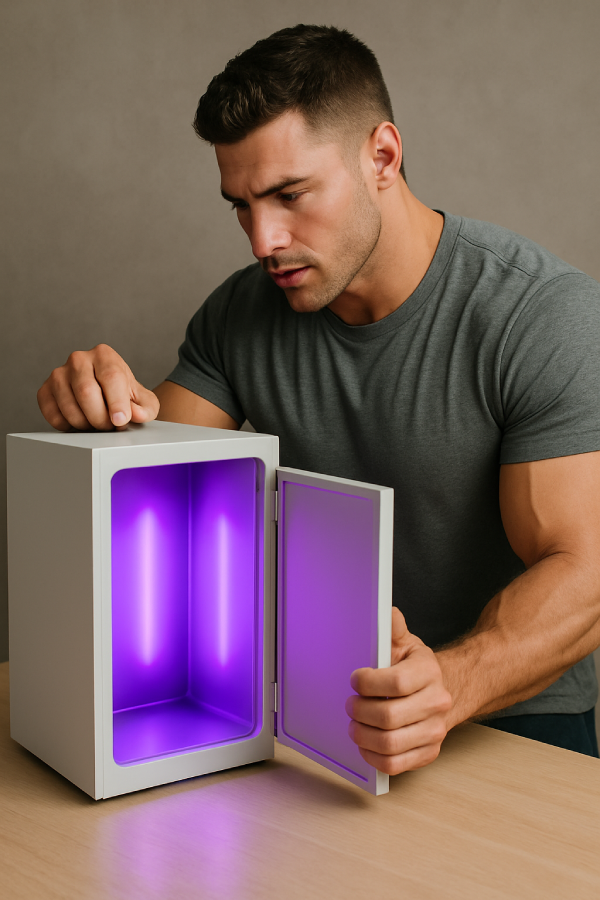
  3. Insert toy into fully enclosed UV unit.
  4. Follow timer instructions provided by unit manufacturer (typically 15 minutes).
-
Figure 5.6: UV Units Limited Size

UV units are typically small and can handle only certain toys (usually less than 15 inches).

SUPPLIES
  • Mild soap for initial cleaning
  • Clean, Dry Towels
  • UV Unit

Additional Insights

UV units are unlikely to remove scents absorbed by the toy.

UV units have size limitations and may not work for larger toys used by many fisters.

Extended exposure to UV radiation will degrade almost anything over time, including toys. Cheaper toys will discolor and show aging faster than more expensive, silicone toys.

Course Appendix

The following material may guide the development and deployment of this topic:

Objectives

Upon completing this course, the student will be able to:

  • Explain why disinfection and sterilization are not viable cleaning options for most toy enthusiasts.
  • Give two reasons why using the dishwasher to clean toys is problematic.
  • Identify one method for eliminating odor from toys.
  • Share one etiquette protocol and two standard practices related to cleaning toys.
  • Demonstrate how to wash and how to sanitize sex toys.

Supplemental Content

Blog Articles

  • Safeguarding Your Cleanout Toy
  • Five Mistakes in Cleaning Sex Toys
  • The Hard Truth about Sharing Sex Toys
  • How to Make Your Own Powerwash

F2 Promotional Materials

  • Skills:
  • Protocols: Cleaning up After a Play Session / Guest Edition
  • FWOTD:
    • Disinfect & Sanatize
    • Residual Odor
    • Borosilicate Glass
    • Micro-pocking
    • Powerwash
    • Cleanout Toy
    • Night/Day Plugging

Outline (Proposed)

  • Basic and Intensive Cleaning
  • Levels of Decontamination
  • Washing
  • Sanitization
  • Disinfection
  • Sterilization
  • Cleaning Guidance (Flowchart Assessment)
  • Cleaning Myths and Misconceptions
  • Odor Removal
  • Residual Odors
  • Elimination Strategies
  • All Toys
  • Silicone Toys
  • Best Practices and Expert Advice
  • Manufacturer Advice for Cleaning Toys
  • Summary of Vendor Guidelines
  • Advice from the Experts
  • Myths and Misconceptions
  • Questions and Answers
  • Protocols
  • Etiquette
  • Standards
  • Procedures
  • Wash Toys
  • Sanitize Toys for Shared Use
  • Remove Odors in Silicone Toys
  • Inhibit Further Mold Growth in Silicone Toys

Brain Dump - Staging Area


Publication Quick Links

Developer's Toolkit | Nu HTML Checker